


Separate measurement from reporting
The probe measures its local temperature. A tracker receives the sensor payload and forwards it to a server; the platform interprets the value and may evaluate alert rules. A successfully delivered packet does not prove that the probe was placed correctly. Likewise, a good probe does not guarantee that a delayed value will be recognised as stale. Specify the acceptable measurement interval, reporting delay and missing-data behaviour before deployment.
A documented EDVADO example
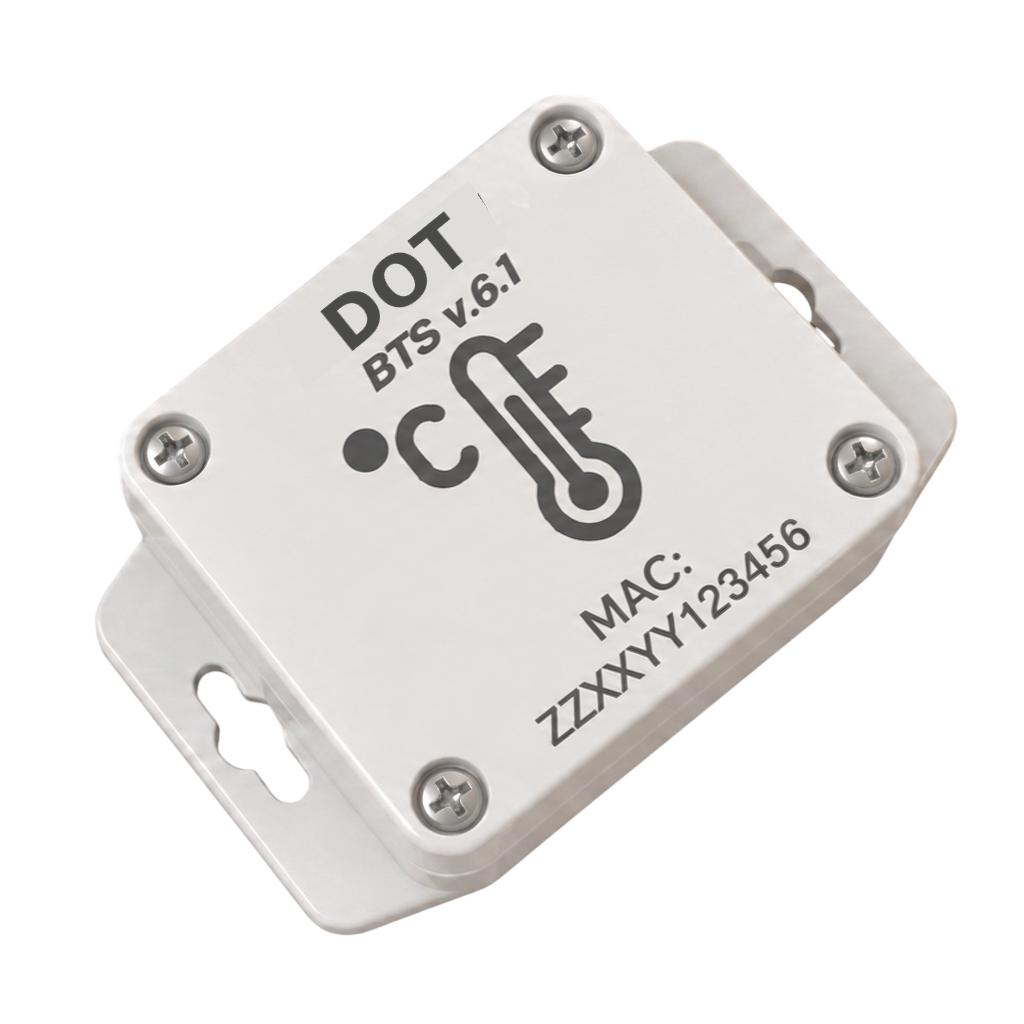
The DOT BTS v6.1 manual describes temperature measurement and monitoring of an external dry-contact circuit, with BLE transmission. It documents internal/external temperature-sensing arrangements, an ER14505 battery and IP67 housing protection. The quoted open-area radio range is not a guaranteed range through a metal refrigerated body. Use the manual for the exact supplied variant; do not infer an industry certification or a complete cold-chain compliance claim from these specifications.
Place the sensor for the question
Air close to an evaporator, a door or a warm wall may differ from air around the load. Decide whether the measurement is intended to represent cargo-zone air, a particular compartment or a specific point. Do not describe an air sensor as measuring product-core temperature. For multi-zone vehicles, plan separate measurement points. Confirm the positions during commissioning and record them so that later readings remain comparable.
Test radio reception under real conditions
Test with the cargo doors closed and a representative load in place. Metal, insulation, liquids and the position of the receiver affect propagation. BLE version numbers alone do not establish application compatibility: the tracker must decode the selected sensor format. Check sensor identity, receiving slot and the corresponding platform field. The BTS manual includes integration information for tracking platforms; the actual tracker and firmware combination still needs verification.

Distinguish an excursion from a gap
A temperature limit, a persistence time and a missing-data timeout solve different problems. An excursion rule evaluates available measurements; a missing-data rule detects absence of trustworthy updates. Keeping the last temperature on screen without its timestamp can hide a broken link. Store or display when the measurement was taken and when it was received whenever the integration supports those times.
Example: validating an alert rule
Imagine a demonstration rule that flags readings above a project-defined limit for ten minutes. The ten-minute duration is only an example, not a food or pharmaceutical standard. Test a controlled change within the equipment's permitted conditions, record reference readings and check the arrival time of the event. Then separately interrupt reception in a controlled test and verify that the system reports missing data rather than treating the old reading as current. Agree the actual limits with the cargo owner and the applicable process requirements.
Door state adds context, not proof
A dry-contact input can help relate door events to temperature changes if the selected installation supports it. A door opening does not automatically explain every excursion, and normal air recovery does not establish that the cargo remained compliant. The BTS manual warns not to apply voltage to the circuit-monitoring wires. Use the model-specific instructions and appropriate contact hardware; do not substitute a powered signal without checking the interface.
Handover and maintenance
Record sensor identity without publishing it, placement, configuration, reference checks, battery information and platform mapping. Plan inspection and calibration according to your process; battery life varies with settings and conditions. Explore DOT BTS v6.1, its manual and Locavist with EDVADO. Provide compartment count, temperature range, vehicle construction and reporting needs when requesting a solution. A real project must validate the full sensor–tracker–platform chain.